Beyond Slots — The Games Most Guides Ignore
Slots dominate sweepstakes casino lobbies by volume, by marketing spend, and by player attention. But they’re not the only games generating SC wins and real cash redemptions. Bingo, keno, and scratch cards occupy a quieter corner of the platform — less flashy, less promoted, and less understood by the player base that defaults to spinning reels. For the players who discover them, these formats offer a different pace, a different engagement style, and in some cases, a different value proposition than the slot-centric experience most guides focus on.
The overlooked status of non-slot games is partly a visibility problem. Platforms feature slots front and center because they generate the highest engagement and the most GC purchases. Bingo rooms, keno draws, and scratch card sections sit deeper in the navigation — accessible but not advertised. This guide covers how each format works on sweepstakes platforms, what SC earning potential they offer, and where to find the best non-slot gaming. Not just slots — and the alternatives are worth knowing about.
Bingo on Sweep Platforms: How It Works
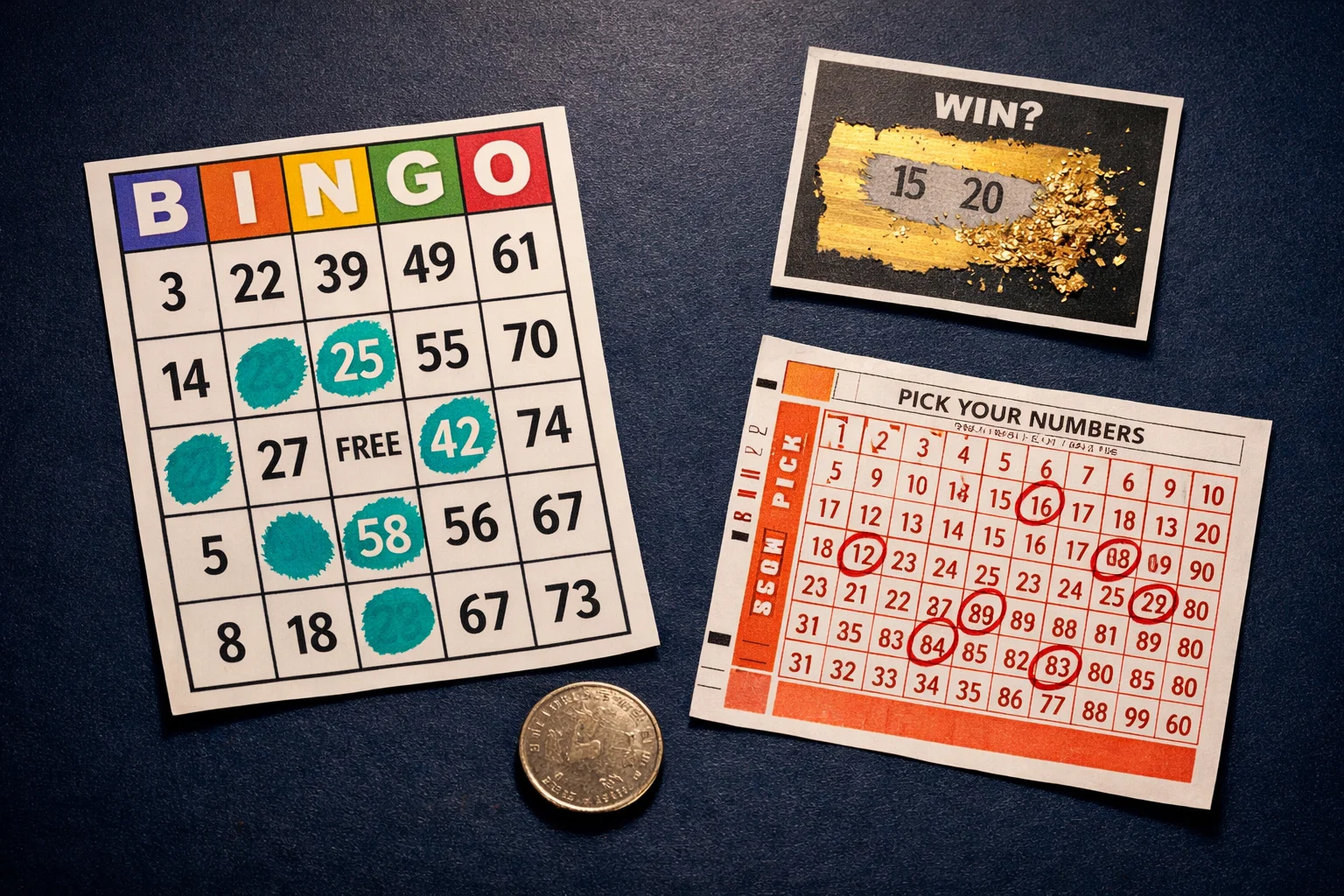
Sweepstakes bingo translates the physical game into a digital format with a few adaptations for the online environment. You purchase bingo cards using Gold Coins or Sweeps Coins — the number of cards per game varies by room, typically ranging from 1 to 30 — and join a scheduled round with other players. Numbers are drawn automatically by the RNG, and the system marks your cards for you. When a winning pattern is completed (horizontal line, vertical line, full house, or special patterns depending on the variant), the prize is credited to your balance.
The social element distinguishes bingo from most other sweepstakes games. Bingo rooms typically include a chat feature where players interact during draws, creating a community dynamic that slots and table games don’t replicate. For a segment of the 55 million Americans who play sweepstakes games annually, the social appeal of bingo is the primary draw — the prizes are a bonus on top of an interactive group experience.
Bingo variants on sweepstakes platforms include 75-ball (the standard American format with a 5×5 card and a free center space), 90-ball (the UK format with three horizontal lines and prizes for one-line, two-line, and full-house completions), and speed bingo (30-ball, played on a 3×3 grid with faster draws and quicker rounds). The variant affects both the session length and the prize structure. 75-ball games run 10 to 15 minutes; speed bingo rounds complete in under 3 minutes.
Prizes in SC-mode bingo are typically structured as pools — a percentage of total card purchases for the round is redistributed as prizes, with the platform retaining a margin (usually 10% to 20%) as the house take. This rake-based model means your expected return depends on the number of players and cards in play, not on a fixed RTP like a slot.
Keno: Quick-Draw Style with SC
Keno is the lottery-style game available on a growing number of sweepstakes platforms. The mechanics are simple: you select a set of numbers (typically 1 to 15 from a field of 80), the game draws 20 numbers at random, and payouts are based on how many of your selections match the drawn numbers. More matches mean higher payouts, with the top prizes reserved for players who match 10 or more numbers from a 15-number selection — an event with astronomically low probability.
Keno’s RTP is generally lower than slots — most keno variants on sweepstakes platforms return between 92% and 95%, compared to the 95% to 98% range common among well-configured slots. The lower return is the tradeoff for simplicity and speed: a keno round takes seconds, requires no strategy beyond number selection, and delivers results faster than any slot bonus round. For players who prefer rapid, low-engagement gameplay with occasional surprise payouts, keno fills a niche that slots address differently.
The SC earning potential in keno is modest for most sessions. The house edge is higher per round, and the variance is extreme — long stretches of small or zero returns interrupted by occasional significant hits when multiple numbers match. Keno is best approached as a diversion between slot sessions or a quick-play option during short breaks, not as a primary SC accumulation strategy.
Scratch Cards: Instant Wins and RTP
Digital scratch cards replicate the experience of physical lottery scratchers: you buy a card, reveal the symbols or numbers hidden beneath a virtual foil layer, and learn immediately whether you’ve won. The results are predetermined by the RNG at the moment of purchase — the “scratching” animation is purely aesthetic. Whether you scratch left to right, top to bottom, or all at once, the outcome doesn’t change.
Scratch card RTP on sweepstakes platforms typically ranges from 85% to 95%, varying by title and provider. This is generally lower than slot RTP, which means the house edge per card is higher. The offsetting factor is that scratch cards have no playthrough mechanics — you buy a card, you get a result, and any SC won is immediately credited to your balance. There’s no bonus round to trigger, no wagering cycle to complete, and no session extension to manage. The simplicity makes scratch cards the most transparent game format on the platform: you know the cost, you see the result, and the math per card is straightforward.
The broader payout context applies. With operator-level payout rates averaging 68% to 72% across the sweepstakes industry per RG.org, scratch cards contribute to that aggregate alongside slots, table games, and other formats. The game-level return on a scratch card might be 90%, but the system-level factors — unredeemed SC, expired balances, cards purchased with GC that bundle SC — bring the industry average below what any individual game returns.
The sweepstakes industry’s evolving structure may bring more attention to non-slot formats. As Seth Schorr, CEO of FSG Digital Inc., noted regarding the formation of the Social and Promotional Gaming Association, building a cohesive industry voice is essential for the sector’s future. Part of that maturation involves standardizing practices across all game types — including bingo, keno, and scratch cards — rather than treating them as secondary to slots. Whether that standardization improves transparency and RTP disclosure for non-slot games remains to be seen, but the direction is toward more structure, not less.
Best Platforms for Non-Slot Games
Platform selection for non-slot gaming starts with a basic reality check: not every sweepstakes casino carries bingo, keno, or scratch cards. The slot-centric market means non-slot content is a differentiator rather than a standard feature, and the platforms that invest in a diverse game library are making a deliberate choice to serve a broader player base.
The largest platforms generally offer the widest non-slot selection. Scale enables provider partnerships that include bingo, keno, and scratch card studios alongside the major slot providers. Smaller platforms may offer one or two scratch card titles as a token gesture without a meaningful bingo room or keno section.
When evaluating platforms for non-slot play, check three things: the number of non-slot titles available (a single scratch card game isn’t a library), whether bingo rooms have active player communities (an empty bingo room isn’t a social experience), and whether non-slot games are available in SC mode or restricted to GC-only play. Some platforms carry bingo and keno for entertainment purposes but don’t allow SC wagers on those game types, which eliminates their value for players interested in prize redemption. Not just slots means verifying that the alternative games participate in the same SC economy as the rest of the lobby — otherwise they’re decoration, not options.
Bingo, Keno & Scratch Cards at Sweepstakes Casinos — More on this topic at sweep slots casino.
See also Site map.