
A $10 Billion Machine Built on Two Currencies
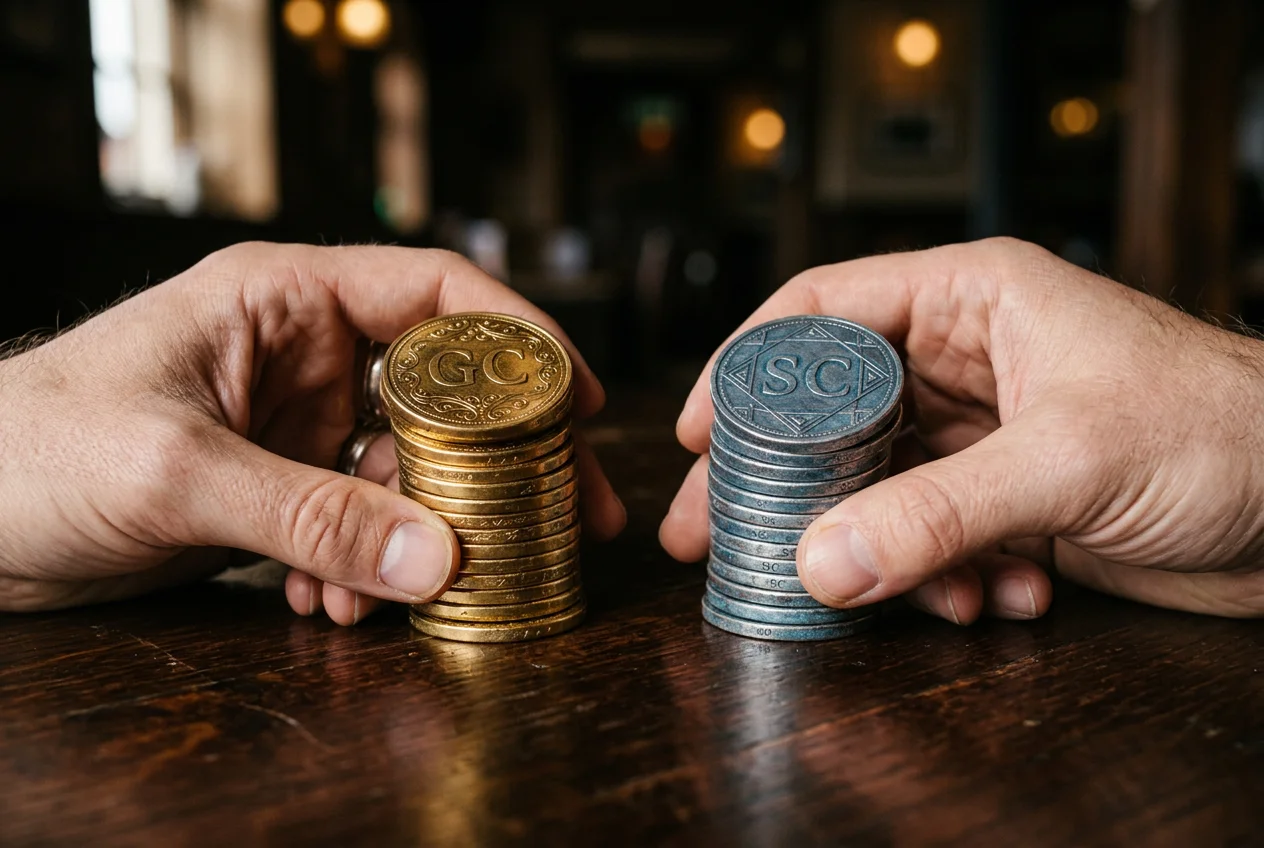
Somewhere between a mobile game and a regulated casino sits an industry that generated $10 billion in Gold Coin purchases during 2024 alone. Sweepstakes casinos have accomplished something that sounds contradictory on its face: they let players win real cash prizes from slot-style games without technically qualifying as gambling under most state laws. The trick is not a loophole. It is an architectural decision — a dual-currency system that splits every transaction into two parallel tracks, each governed by different rules and serving a different purpose.
If you have ever signed up for one of these platforms and wondered why you received two separate coin balances, or why there is a mailing address buried in the terms of service, or why the cashier page sells “Gold Coin packages” instead of credits, the answer lies in the mechanics described below. The entire model depends on keeping those two currencies distinct — legally, functionally, and psychologically. Collapse the boundary between them and the sweepstakes framework falls apart. Maintain it, and you have a business that rivals some publicly traded casino operators in raw revenue.
This article follows the coins. From the moment a Gold Coin enters your account to the moment a Sweeps Coin converts into a bank deposit, each step exists for a reason. Some of those reasons are practical. Most of them are legal. Understanding the difference is the first step toward knowing what you are actually playing — and what you are actually paying for.
The dual-currency model is not new — promotional sweepstakes have existed in American commerce for decades. What is new is the scale. A structure once used to give away soft drinks and magazine subscriptions now underpins an industry where individual operators report billions in annual revenue. The mechanics have not changed much since the first sweepstakes casino launched. The money flowing through them has changed enormously.
Gold Coins: The Free-Play Layer
Gold Coins are the currency you see first. They appear when you register, they refill through daily bonuses, and they are what the platform encourages you to buy. But here is the part that trips people up: Gold Coins have no cash value. Zero. You cannot redeem them, you cannot transfer them, and the platform’s terms of service will state this explicitly in bold text, usually within the first few paragraphs.
So why do they exist? Because Gold Coins are the product being sold. When a player purchases a “$9.99 Gold Coin package,” they are buying virtual entertainment tokens — functionally identical to buying coins in any mobile game. The transaction is a purchase of virtual goods, not a wager. This distinction matters enormously for legal classification, and it is the reason sweepstakes casinos can operate in states where traditional online gambling remains illegal.
On the gameplay side, Gold Coins function identically to any other casino credit. You select a slot, set your bet size in GC, spin the reels, and win or lose Gold Coins. The games are the same. The math models are the same. The animations, sound effects, bonus rounds — all the same. The only difference is what happens when you hit a winning combination: your GC balance goes up, and that balance still cannot be exchanged for money.
This creates an interesting psychological layer. Players engage with Gold Coins in the same way they would engage with real-money credits, because the experience is designed to be indistinguishable. The dopamine response to a big GC win does not know the difference between redeemable and non-redeemable currency. That is the point. Gold Coins keep players active on the platform, spinning through sessions, exploring game libraries, and — critically — returning to the cashier page where Gold Coin packages are displayed alongside their bundled Sweeps Coin bonuses.
Most platforms offer multiple tiers of GC packages, typically ranging from $1.99 to $99.99 or higher. The packages scale in a way that rewards larger purchases: a $4.99 package might include 30,000 GC, while a $49.99 package includes 500,000 GC plus bonus Sweeps Coins. The GC-per-dollar ratio improves as you spend more, following the same pricing psychology used across freemium gaming.
New players typically receive a free GC allocation at registration — anywhere from 10,000 to 250,000 GC depending on the platform. Some sites replenish a smaller amount daily, creating a login incentive even for players who never spend money. The free GC serves a dual purpose: it lets players test the games, and it establishes the habit of checking in regularly.
Sweeps Coins: Where Real Prizes Enter the Picture
Sweeps Coins are the other half of the ledger, and they change everything. Unlike Gold Coins, SC can be redeemed for cash prizes — typically at a 1:1 ratio with USD, though some platforms set slightly different rates. When a player accumulates enough Sweeps Coins and meets the platform’s verification requirements, those coins convert into a real bank deposit or gift card. This is the mechanism that makes sweepstakes casinos something more than a free mobile game.
The critical legal detail: you cannot buy Sweeps Coins directly. They arrive as a free bonus attached to Gold Coin purchases, or through promotional giveaways, or via the Alternative Method of Entry described in the next section. The platform never sells SC. It sells GC and gives away SC alongside the purchase. This distinction — “received for free” versus “purchased” — is the load-bearing wall of the entire sweepstakes legal framework.
In practice, the ratio of free SC bundled with GC purchases varies by platform and package size. A $9.99 GC package might include 3 SC, while a $49.99 package includes 35 SC. The SC-per-dollar ratio typically improves at higher price points, mirroring the GC pricing structure. Players who follow the coins quickly realize that the Gold Coins are the wrapper and the Sweeps Coins are the actual value proposition.
Gameplay with Sweeps Coins is mechanically identical to Gold Coin play. The same slots, the same bet ranges (adjusted for SC denomination), the same RTP percentages. But the stakes feel different because the outcome is redeemable. Data from Responsible Gambling research (RG.org) indicates that the average operator payout rate sits between 68% and 72% — meaning for every $100 in GC purchases (with their bundled SC), players collectively redeem $68 to $72 in prizes. That figure is not the same as the RTP of an individual slot game, which typically runs between 94% and 97%. The gap between game-level RTP and operator-level payout reflects unclaimed prizes, playthrough requirements, and the simple fact that many players never redeem at all.
According to data tracked by Eilers & Krejcik Gaming, only about 12% of sweepstakes casino users ever make a purchase, and the typical first buy is under $10. That means the vast majority of players interact exclusively with free coins — Gold Coins from registration bonuses and Sweeps Coins from promotions. The paying minority funds the entire ecosystem, a dynamic familiar to anyone who has studied free-to-play mobile gaming economics.
AMOE: The Legal Backbone of “No Purchase Necessary”
If the dual-currency system is the engine, AMOE is the legal fuel that keeps it running. Alternative Method of Entry — sometimes called “no purchase necessary entry” — is the mechanism that prevents sweepstakes casinos from being classified as gambling under federal and most state laws. It is also the most misunderstood component of the entire model.
The logic works like this. Traditional gambling, as defined by most US jurisdictions, requires three elements to be present simultaneously: consideration (something of value paid by the player), chance (a random outcome), and prize (something of value awarded to the winner). Remove any one of those three elements and the activity falls outside the legal definition of gambling. Sweepstakes casinos target the first element — consideration. By providing a genuinely free path to obtaining Sweeps Coins, they argue that no purchase is necessary to participate in the prize-eligible sweepstakes. As Magnus Boberg, founder of JustGamblers, explained it: “Traditional gambling requires three elements: consideration, chance, and prize. Sweepstakes sites do not require payment, so they bypass regulations that apply to traditional online gambling.” That framing — the elimination of mandatory consideration — is the entire legal thesis.
In practice, AMOE takes several forms. The most common is the mail-in request: players send a handwritten letter or postcard to a specified address, and the operator credits a small number of free Sweeps Coins to their account. The exact process varies by platform. Some require specific language in the letter. Others accept a simple request with the player’s username and registered email. Processing times range from a few days to several weeks, and the SC amount per request is typically modest — often 5 SC or fewer per letter.
Beyond mail-in requests, many platforms offer additional free SC channels. Social media giveaways are common: follow the casino’s Facebook page, engage with a promotional post, and receive a small SC credit. Some operators run daily or weekly sweepstakes drawings that award SC to random participants. Others grant free SC as part of registration bonuses, email promotions, or in-app challenges.
The uncomfortable reality is that AMOE, while legally necessary, is rarely the primary way players acquire Sweeps Coins. Sending handwritten letters for a few SC when a $9.99 GC purchase bundles significantly more is — by design — not an attractive proposition for most users. The free path exists to satisfy a legal requirement, not to serve as the dominant acquisition channel. Critics of the sweepstakes model point to this disparity as evidence that AMOE is a fig leaf: technically available, practically irrelevant. Defenders counter that the legal standard does not require the free method to be equally convenient, only that it exist and be genuinely available.
Courts have generally sided with the operators on this point, though the landscape is shifting. Several of the class-action lawsuits filed against sweepstakes casinos in 2025 challenged the adequacy of AMOE provisions, arguing that the free entry path was so burdensome relative to the purchase path that it failed to meaningfully eliminate consideration. Those cases are still working through the legal system, and their outcomes could reshape how AMOE is implemented industry-wide.
For players, the practical takeaway is straightforward: AMOE is real, it works, and you can use it. Whether it is worth the effort depends entirely on how you value your time versus the SC amount received. For the legal framework, though, it is not optional. Without a functioning AMOE pathway, a sweepstakes casino loses its primary defense against gambling classification — and with it, its ability to operate in most US states.
The Purchase Flow: What Happens When You Buy Gold Coins
Follow the coins through an actual purchase and the dual-currency architecture becomes concrete. A player opens the cashier page, selects a Gold Coin package — say, 100,000 GC for $19.99 — and the listing notes “Includes 10 FREE Sweeps Coins” somewhere beneath the price. The player pays with a credit card, debit card, or one of the platform’s accepted payment methods (ACH, PayPal, cryptocurrency on some sites). The transaction processes as a purchase of virtual goods. No gambling transaction codes. No age-restricted payment flags. Just a standard e-commerce charge.
Once the payment clears, two things happen simultaneously. The 100,000 GC credits to the player’s Gold Coin balance, available immediately for free play on any game. The 10 SC credits to a separate Sweeps Coin balance, also available immediately but governed by different rules. Some platforms impose a playthrough requirement on the bonus SC — typically 1x, meaning the coins must be wagered once before they become eligible for redemption. Others credit them with no strings attached.
The payment processing side of this equation is worth understanding. Sweepstakes casinos process purchases through standard merchant accounts, not through the restricted categories used by licensed gambling operators. This distinction has practical consequences: credit card issuers that block gambling transactions generally do not block sweepstakes purchases, and the interchange fees are processed at standard e-commerce rates. For the operators, this means lower processing costs and broader payment acceptance. For players, it means purchases that show up on credit card statements as generic merchant charges rather than gambling transactions.
The economics of customer acquisition shape how these packages are priced. According to Gaming Innovation Group’s investor data, the cost to acquire a single sweepstakes casino user runs between $50 and $100, which is lower than traditional regulated gaming but still substantial. That CAC figure explains the aggressive welcome bonuses: first-purchase offers that triple or quadruple the normal SC allocation exist to convert a registered free player into a paying customer, because the lifetime value math only works once a player makes that initial buy.
The purchase funnel follows predictable patterns. New players register, play with free GC, encounter the cashier page through in-app prompts, and face a decision. Most never buy — the 12% conversion rate cited earlier means nearly nine out of ten users remain free players indefinitely. But those who do buy tend to buy again. The platforms are engineered to make the second purchase easier than the first, with personalized offers, limited-time bundles, and push notifications timed to moments when the player’s coin balance runs low.
Redemption: Turning Sweeps Coins Into Cash
Redemption is where the sweepstakes model delivers on its implicit promise. A player with enough Sweeps Coins in their balance can request a conversion to real currency — typically USD — deposited into a bank account, sent via ACH transfer, or loaded onto a prepaid card. Some platforms also offer gift card redemptions or cryptocurrency payouts. The process is real. People receive real money. This is not a technicality.
But redemption comes with conditions, and those conditions vary significantly across platforms. The most important is the minimum threshold. Most operators require players to accumulate a minimum SC balance before requesting a redemption — commonly between 50 SC and 100 SC (equivalent to $50–$100, at the standard 1:1 SC-to-USD ratio). Some platforms set the bar lower, at 10 SC or even 5 SC. Others push it higher. The threshold determines how accessible the cash-out process actually is for casual players who accumulate SC slowly through free promotions and small purchases.
Identity verification adds another layer. Before processing any redemption, platforms require KYC (Know Your Customer) documentation: a government-issued photo ID, proof of address, and sometimes additional verification such as a selfie or social security number confirmation. First-time redemptions typically take the longest — anywhere from 24 hours to 14 business days — because of this verification step. Subsequent redemptions are usually faster, often processing within 1 to 5 business days, though timelines depend on the payout method and the operator’s internal procedures.
Playthrough requirements also gate the redemption process. Most platforms require that SC received as bonuses be wagered at least once (1x playthrough) before becoming redeemable. Some impose higher multipliers — 3x or even 5x — on SC received through specific promotions. SC won through gameplay after the initial wager typically carries no additional playthrough requirement, but the rules vary and the fine print matters. A player who receives 50 SC as a welcome bonus with a 1x playthrough requirement must wager those 50 SC at least once. If they bet 1 SC per spin on a slot and play 50 spins, the requirement is met regardless of whether they won or lost during those spins.
The aggregate payout rate across the industry — 68% to 72% according to RG.org analysis — reflects all of these moving parts: players who redeem, players who never cash out, SC lost through gameplay, and the mathematical edge built into every game. For individual players, the actual return varies enormously: some redeem more than they spent on GC purchases, while others never reach the minimum threshold.
Once a redemption request is approved, the funds move through the operator’s banking partner. Players have reported receiving payouts via direct bank deposit, PayPal, Skrill, and in some cases physical checks. The method available depends on the platform, and not every option is offered everywhere. Geographic restrictions, banking regulations, and the operator’s own risk management policies all influence which redemption channels appear on a given player’s account.
The Business Model Behind the Curtain
Strip away the legal scaffolding and the sweepstakes casino business model is, at its core, a free-to-play monetization engine with a prize layer bolted on top. The revenue formula is simple: sell Gold Coin packages, bundle free Sweeps Coins with each sale, pay out a fraction of those SC as prizes, and keep the rest. The gap between total GC sales and total SC redemptions is gross margin.
The clearest window into this math comes from VGW Holdings, the operator behind Chumba Casino, LuckyLand Slots, and Global Poker. VGW is the largest sweepstakes casino company and one of the few to release financial data publicly. For fiscal year 2022–23, VGW reported approximately AU$3.1 billion in total revenue. The following year — FY 2023–24, ending June 2024 — revenue surged 27% to AU$6.1 billion (approximately US$4.15 billion), with sweepstakes prize payouts of AU$2.83 billion and after-tax profit of AU$492 million. Those numbers put VGW’s payout rate right around 71% — squarely within the industry’s 68–72% range — and its net margin in the low single digits after accounting for operating costs, marketing, and taxes.
VGW’s scale illustrates both the trajectory of the industry and the market concentration within it. A single operator accounting for billions in annual revenue in an industry with gross sales of $10.6 billion means the market is heavily concentrated at the top. VGW alone represents a significant share of total US sweepstakes casino activity.
The cost structure favors operators who can scale. Customer acquisition costs of $50 to $100 per user are significant, but the lifetime value of a converting player — one who makes repeat purchases over months or years — can be multiples of that figure. Marketing spend is front-loaded: heavy advertising to acquire users, followed by retention mechanics (daily bonuses, loyalty tiers, personalized offers) that cost far less to maintain. VGW reportedly spent around $300 million on advertising, including campaigns featuring high-profile celebrity endorsements, an investment that makes sense only if the return per acquired customer justifies the outlay.
The whale dynamic further concentrates revenue. With only 12% of users making any purchase and the typical buy-in under $10, the revenue distribution is heavily skewed. A small number of high-frequency, high-value players generate a disproportionate share of GC sales. This is the same pattern observed in mobile gaming broadly — a few percent of users produce the majority of revenue — but in sweepstakes casinos, the prize redemption layer adds a variable that pure entertainment apps do not have. Whales are not just buying entertainment; they are buying chances at redeemable prizes, and their spending patterns reflect that additional motivation.
Operating costs include game licensing fees (or development costs for proprietary titles), payment processing, platform infrastructure, customer support, KYC verification, legal compliance, and the expanding expense of navigating a regulatory landscape that grows more hostile each year. Operators who once built their business in a relatively unregulated space are now hiring compliance teams, engaging lobbyists, and defending against class-action lawsuits — costs that did not exist at scale even three years ago.
For players following the coins all the way through, the picture is clear. The money enters as a Gold Coin purchase. It passes through a game engine that returns most of it through play but retains a mathematical edge. What remains becomes either an unredeemed SC balance or a cash payout. The operator keeps the difference between what was sold and what was redeemed, minus the cost of running the platform. It is a business model that looks like a casino, acts like a casino, and generates casino-scale revenue — built on a legal framework that says it is not a casino at all.
How Sweepstakes Casinos Work — More on this topic at sweep slots casino.
See also Best Sweepstakes Casino Apps for Mobile Players in 2026.