Six Bans in Twelve Months — and More Coming
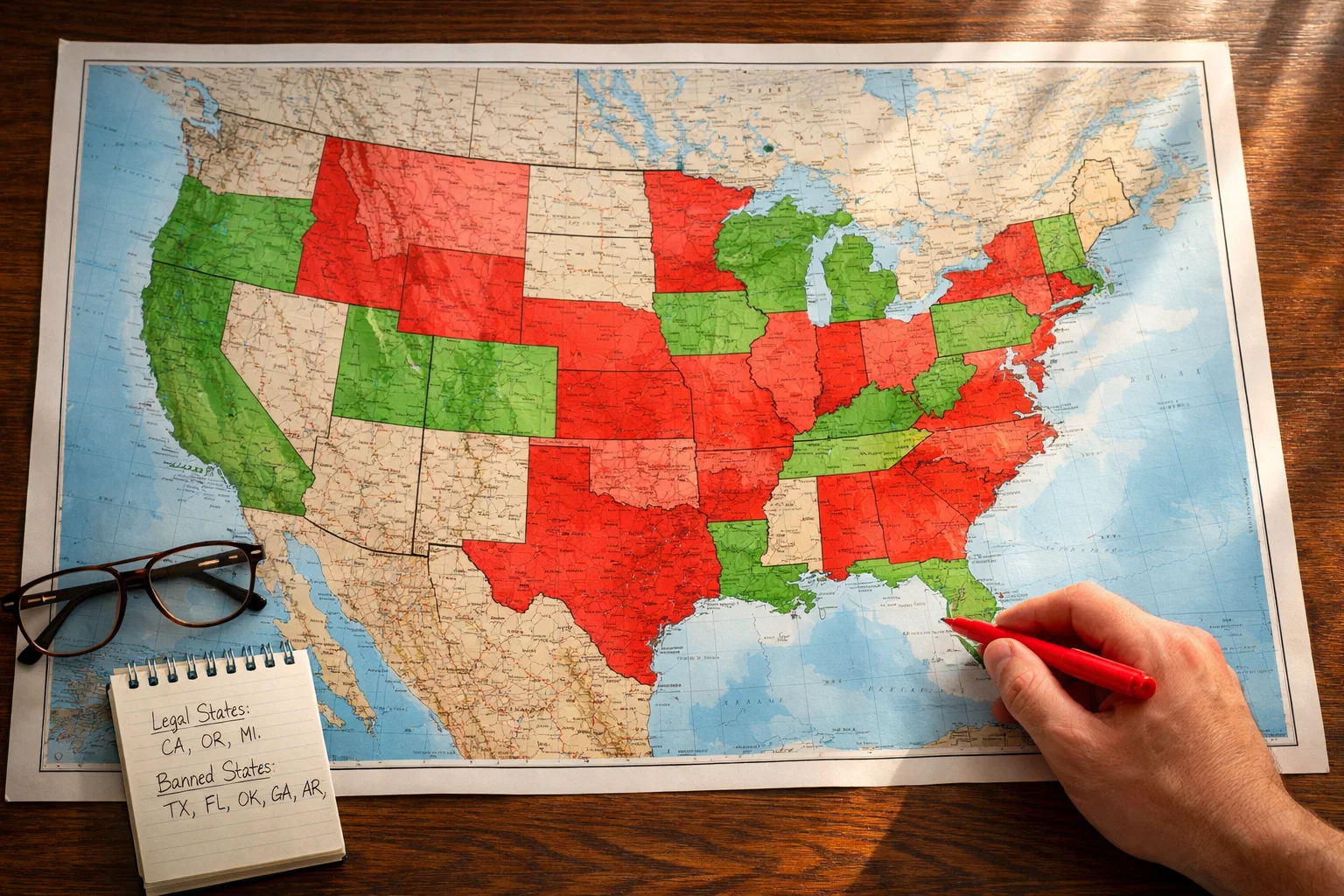
In January 2025, sweepstakes casinos operated with minimal legislative interference across the vast majority of the United States. By December, six states had enacted bans or significantly escalated enforcement against them: Montana, Connecticut, New Jersey, California, New York, and Nevada. The speed caught the industry off guard. The breadth of it — stretching from the Northeast to the Pacific coast, from small states to the nation’s largest consumer markets — signaled something more than a few isolated crackdowns. It was the beginning of a state-by-state reckoning that shows no sign of slowing in 2026.
The legal landscape for sweepstakes casinos has never been simple, but it used to be predictable. Operators relied on the sweepstakes model — dual currency, no purchase necessary, free entry via AMOE — to stay outside the legal definition of gambling in most jurisdictions. That framework still holds in the majority of states. What changed in 2025 was the willingness of legislators and attorneys general to challenge it directly, with new statutes that target the sweepstakes model by name and enforcement actions that treat it as unlicensed gambling regardless of the legal structure.
This article maps the current legal status of sweepstakes casinos across every US state, breaks down the 2025 ban wave in detail, tracks the bills moving through 2026 legislative sessions, and examines the economic consequences of prohibition for both operators and players. The data is current as of early 2026, but the situation is fluid. Bills are advancing, lawsuits are pending, and the regulatory picture could shift within weeks.
Where Sweepstakes Casinos Are Legal Right Now
As of early 2026, sweepstakes casinos remain accessible to players in roughly 42 states plus the District of Columbia. That number is approximate because legality is not always binary — some states have unclear statutes, pending legal challenges, or enforcement policies that create gray areas even without explicit bans. But for practical purposes, if you live outside the handful of states that have enacted specific prohibitions, you can sign up, play, and redeem prizes at most major sweepstakes platforms.
The reason so many states remain open is structural. Sweepstakes casinos operate under promotional sweepstakes law, not gambling law. Most US states have sweepstakes statutes that permit promotional contests with prizes, provided there is a free method of entry and no purchase is required to participate. The dual-currency model — Gold Coins as purchased virtual goods, Sweeps Coins as free promotional entries — was specifically designed to fit within this framework. Until a state either amends its sweepstakes law to exclude casino-style games or passes new legislation targeting the model directly, operators can and do argue that they are running a legal sweepstakes promotion.
The American Gaming Association’s 2025 survey of sweepstakes casino players found that monthly player numbers were roughly twice as high in states without active bans compared to states with restrictions — an intuitive finding, but one that quantifies the demand gap that bans create. Players in legal states do not just have access; they have substantially higher engagement levels, which translates directly into revenue for operators.
Among the states where sweepstakes casinos currently operate freely, a few stand out for the volume of activity they generate. Texas, Florida (pending 2026 legislation), Pennsylvania, Ohio, and Illinois rank among the largest markets by player count and estimated spend. States without legalized iGaming — which includes the majority of the country — tend to show the highest sweepstakes casino adoption, because the platforms fill a gap that regulated online casinos have not yet occupied. In states like New Jersey and Michigan, where licensed online casinos already exist, sweepstakes platforms historically had smaller market share relative to population, though even there, the platforms attracted players who preferred the sweepstakes model or were not eligible for regulated gambling accounts.
Idaho and Washington have longstanding restrictions on sweepstakes-style gaming that predate the current wave of bans, and most operators have historically excluded those states voluntarily. The distinction matters: some states were never open, while others opened and then closed. The players affected by the 2025 bans had established accounts, built balances, and developed playing habits — and then lost access.
2025 Ban Wave: State-by-State Breakdown
The 2025 legislative cycle delivered the most concentrated period of sweepstakes casino prohibition in the industry’s history. Six states moved against the model through new legislation or aggressive enforcement, and the collective impact was severe enough to force industry analysts to revise their revenue projections downward. Here is what happened in each state, in roughly chronological order.
Montana
Montana was among the earliest movers. The state legislature passed a bill classifying sweepstakes casino games as illegal gambling under existing state code. The measure faced minimal organized opposition — Montana’s market was small relative to other states, and the industry’s lobbying infrastructure was not yet geared for a multi-state defensive campaign. The ban took effect mid-year, and major operators withdrew from the state within weeks of the governor’s signature.
Connecticut
Connecticut’s ban reflected the influence of its tribal gaming compacts. The Mohegan and Mashantucket Pequot tribes, which operate the state’s two major casinos and have exclusive rights to certain forms of gaming, pushed for legislation that would close what they viewed as an unregulated competitor. The resulting statute specifically targeted online sweepstakes gaming, and operators complied quickly given the legal clarity of the tribal compact framework.
New Jersey
New Jersey presented an ironic case: the state that pioneered legal online casino gaming in the US decided that sweepstakes casinos, which operate outside its regulatory framework, had no place alongside its licensed operators. The ban aligned with New Jersey’s broader position as a regulated-market state where competition from unlicensed platforms was viewed as a threat to tax revenue and consumer protection standards. The Division of Gaming Enforcement had been monitoring sweepstakes platforms for months before the legislature acted.
California
California was the largest domino to fall, and it fell hard. The state represented approximately 17.3% of all sweepstakes casino sales in the United States, according to Eilers & Krejcik Gaming data — making it the single most valuable market for operators. Governor Newsom signed AB 831 into law on October 11, 2025, with an effective date of January 1, 2026. The law imposed penalties of up to $25,000 in fines and up to one year of imprisonment for operating sweepstakes casino games, and it extended liability to vendors and service providers who facilitate the platforms, not just the operators themselves.
The political dynamics in California were notable. Tribal gaming interests, which had defeated a broader online gambling ballot measure in 2022, pushed aggressively for the sweepstakes ban. The industry’s defense found no traction. As Shawn Fluharty, West Virginia Delegate and President of the National Council of Legislators from Gaming States (NCLGS), remarked: “They couldn’t get one vote in California. You know how hard that is? They can’t agree on the colour of the carpet.” The unanimous opposition underscored how thoroughly the political environment had turned against sweepstakes operators in the state.
New York
New York’s action combined legislation with enforcement. The state’s sweepstakes casino market generated an estimated $762 million in sales during 2024, making it the second-largest individual state market after California. Governor Hochul signed S5935, a ban on sweepstakes casino operations, and Attorney General Letitia James followed up with cease-and-desist letters to 26 operators. The dual approach — legislative prohibition backed by the AG’s enforcement authority — left operators with no ambiguity about New York’s position.
The speed of New York’s action caught some in the industry by surprise. The state had been discussing iGaming legalization for years without reaching consensus, and some operators had assumed that sweepstakes platforms would be tolerated as a stopgap until regulated online casinos launched. Instead, the legislature chose to close the sweepstakes channel before opening a regulated one — a sequencing decision that prioritized eliminating unregulated competition over providing immediate consumer access to online casino games.
Nevada
Nevada took a different approach than the other five states. Rather than passing new legislation, the state relied on its existing gaming regulatory framework and its powerful Gaming Control Board to escalate enforcement against sweepstakes operators. Nevada’s position was straightforward: the state regulates gaming more thoroughly than any other jurisdiction in the country, and any casino-style operation that has not obtained a Nevada gaming license is, by definition, operating illegally. The enhanced enforcement made it impractical for sweepstakes platforms to continue accepting Nevada residents.
Taken together, these six bans removed some of the industry’s largest and most valuable markets from the map. The revenue impact was immediate and substantial — significant enough that industry analysts were forced to revise their forecasts downward multiple times, as the economic section below details.
2026 Legislative Session: Bills to Watch
The state-by-state reckoning did not end with the 2025 session. As of early 2026, at least four states have introduced legislation that would ban or heavily restrict sweepstakes casinos, and additional bills could emerge as sessions progress.
Florida — HB 591
Florida’s HB 591 targets sweepstakes casino operations directly. The bill would prohibit the operation, promotion, and facilitation of sweepstakes gaming platforms that offer casino-style games with prize redemption. Florida is one of the largest remaining markets for sweepstakes operators — the state’s large population, limited iGaming options, and warm demographic overlap with the sweepstakes casino player base make it a high-value target for both operators and regulators. The Seminole Tribe, which operates under a gaming compact with the state, has been vocal about eliminating what it considers unlicensed competition. If HB 591 passes, the revenue implications for the industry would rival the California ban.
Indiana
Indiana has introduced legislation to classify sweepstakes casino games as illegal gambling under state code. The bill follows the template established by the 2025 bans — targeting the sweepstakes model specifically rather than attempting to regulate it. Indiana’s licensed casino industry, which includes both commercial and tribal operators, has supported the measure. The bill is moving through committee with bipartisan backing, though the timeline for a floor vote remains uncertain.
Maine
Maine’s approach is somewhat narrower. The proposed legislation would restrict the promotional sweepstakes exemption to exclude games that simulate casino-style gambling, effectively carving sweepstakes casinos out of the existing sweepstakes framework without banning other types of promotional contests. If enacted, it would be one of the more surgically targeted laws in the space — addressing the specific products at issue without disrupting broader sweepstakes law.
Mississippi — SB 2104
Mississippi’s SB 2104 represents an aggressive push to prohibit sweepstakes casino activity in a state with a well-established brick-and-mortar casino industry along the Gulf Coast and in the Mississippi Delta. The bill has drawn support from the Mississippi Gaming Commission and casino operators who view sweepstakes platforms as unregulated competitors siphoning revenue from a tax-paying industry. Mississippi’s legislative calendar puts the bill on track for a vote during the first half of 2026.
Beyond these four, industry observers are monitoring activity in several additional states where lawmakers have expressed interest in sweepstakes regulation. Some states are considering regulation rather than outright prohibition — potentially requiring sweepstakes operators to obtain state licenses, pay gaming taxes, and meet consumer protection standards similar to those imposed on traditional online casinos. That regulatory approach has not been enacted anywhere yet, but it represents an alternative to the ban-first strategy that dominated 2025.
The momentum is clear. Each ban that passes gives political cover to legislators in neighboring states. The AGA and state gaming associations continue to lobby aggressively for prohibition, while the Social and Promotional Gaming Alliance (SPGA) and Social Gaming Leadership Alliance (SGLA) argue for regulation as a preferable alternative. The outcome in 2026 will depend on which argument proves more persuasive — and how much revenue is at stake in each state where the debate is active.
Economic Impact: What Bans Actually Cost
The political narrative around sweepstakes casino bans tends to frame prohibition as a clean win: shut down unregulated gambling, protect consumers, preserve revenue for licensed operators. The economic reality is more layered, and the costs are distributed across parties that rarely appear in the legislative debate.
The most detailed economic impact analysis available focuses on New York. According to an Eilers & Krejcik Gaming study commissioned by the SGLA, the sweepstakes casino industry generated over $230 million in annual economic impact for the state of New York in 2024. That figure includes more than $135 million in interchange fees earned by New York-based card-issuing banks — revenue generated every time a New York resident purchased a Gold Coin package using a credit or debit card. When the state banned sweepstakes casinos, those interchange revenues did not transfer to regulated gambling operators. They simply disappeared.
The New York case illustrates a broader pattern. Sweepstakes casino spending does not exist in a vacuum — it generates economic activity across payment networks, technology providers, customer support vendors, and marketing channels. Bans eliminate the consumer-facing product but also disrupt the downstream commerce that the product sustained. Some of that spending may shift to legal alternatives (licensed online casinos, if available; brick-and-mortar casinos; other entertainment). Some of it evaporates. And some of it migrates to offshore platforms with no regulatory oversight at all — a consequence that ban proponents rarely address but that player behavior data consistently suggests.
For operators, the financial impact of the 2025 ban wave was measurable and immediate. The Eilers & Krejcik downward revision — from $4.7 billion to $4 billion in projected 2025 net revenue, followed by a 10% decline forecast for 2026 bringing the estimate to $3.6 billion — captures the aggregate effect. But the pain is not evenly distributed. Smaller operators with concentrated player bases in banned states faced existential revenue losses. Larger companies with nationwide reach, like VGW, absorbed the bans as a reduction in growth rather than a threat to viability.
State tax revenue tells another part of the story. Sweepstakes casinos do not pay state gaming taxes — they operate as sweepstakes promotions, not licensed gaming businesses — so banning them does not cost a state direct tax revenue the way shutting down a regulated casino would. But the spending that players redirected away from sweepstakes platforms did not automatically flow into taxable channels. In states without legal iGaming, the most likely alternatives are entertainment options that generate lower tax yields per dollar spent, or no taxable spending at all. The tax argument for bans depends on what replaces the banned activity, and in most states, the replacement is uncertain.
How Players in Banned States Are Affected
When a state bans sweepstakes casinos, the operators withdraw. Geolocation technology blocks access from IP addresses within the state. Existing accounts belonging to residents are flagged. What happens next varies by platform, but the general sequence is consistent: players receive a notification that the service is no longer available in their state, they are given a window to redeem any remaining Sweeps Coins balance, and after that window closes, their accounts become inactive.
The redemption window is the most critical phase. Most operators provide 30 to 90 days for players to cash out their SC balances after a ban takes effect. Players who meet the platform’s minimum redemption threshold and have completed KYC verification can withdraw their balances through normal channels. Players who fall below the threshold, however, may lose access to unredeemed SC — a painful outcome for those who were slowly accumulating coins through free play and promotions. Some operators have offered partial accommodations, such as lowering the minimum threshold temporarily for players in newly banned states, but this is not universal.
Gold Coin balances are typically zeroed out without compensation. Since GC have no cash value under the platform’s terms of service, the operator has no obligation to refund or replace them. For players who spent money purchasing GC packages — even if they did so primarily to receive the bundled SC — the loss of GC represents entertainment value paid for and not fully consumed. It is, functionally, like losing access to a paid game library on a platform that shut down.
Beyond the financial impact, bans create practical disruptions. Players who used sweepstakes casinos as their primary form of online entertainment need to find alternatives. In states with legal iGaming (New Jersey, for example), the transition to regulated online casinos is straightforward, though the product experience is different and sign-up requires meeting the state’s gambling eligibility criteria. In states without legal iGaming — which describes most of the newly banned jurisdictions — there is no legal online casino alternative. Players can visit brick-and-mortar casinos, shift to other forms of online entertainment, or stop playing altogether. Some inevitably seek out offshore platforms, trading the consumer protections of a US-facing sweepstakes site for the risks of an unregulated operator based outside the country.
The VPN myth deserves a direct address. A common suggestion in online forums is that players in banned states can use a VPN to mask their location and continue accessing sweepstakes platforms. This does not work in practice for several reasons. Major operators use multi-layered geolocation that goes beyond IP address detection, incorporating GPS data, Wi-Fi triangulation, and device-level checks. Attempting to circumvent these measures violates the platform’s terms of service and can result in permanent account closure and forfeiture of any remaining balance. More importantly, accessing a banned service from a restricted state may expose the player to legal liability under the very statute that created the ban. The risk is not worth the effort, regardless of what anonymous commenters suggest.
The state-by-state reckoning has reshaped the map of sweepstakes casino availability, and 2026 promises further contraction. For players in states still open, the message is not that bans are inevitable — many states have shown no legislative interest in restricting sweepstakes gaming. But for those in states where bills are advancing, awareness of the timeline and the redemption process is practical preparation. The bans are coming with notice, not overnight. The players who pay attention to the legislative calendar will be better positioned than those who do not.