The Ban List Grew Faster Than Anyone Expected
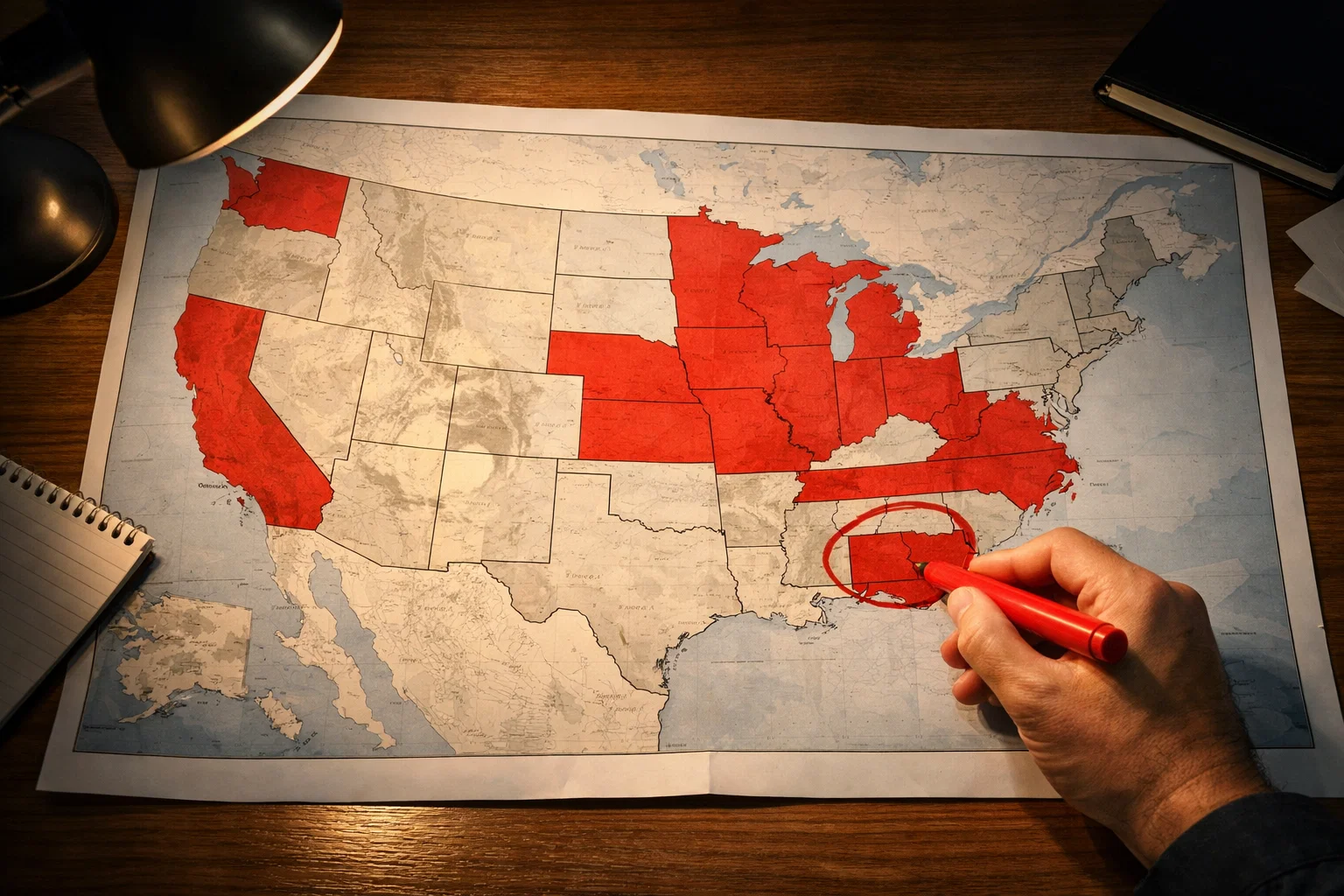
Twelve months ago, the list of states that had explicitly banned sweepstakes casinos could be counted on one hand. By the end of 2025, that number had tripled. Six US states enacted legislative bans on sweepstakes casinos in 2025, according to Gambling Insider — a pace of regulatory action that caught operators, players, and industry analysts off guard. The wave was bipartisan, geographically diverse, and driven by a coalition of regulated gaming interests, consumer advocacy groups, and legislators who concluded that the sweepstakes model was gambling in all but name.
For players, the practical impact is immediate and non-negotiable. If your state has banned sweepstakes casinos, your access is cut off — no new accounts, no deposits, no gameplay, and in many cases, no ability to redeem existing SC balances accumulated before the ban. Banned means banned, and the enforcement mechanisms are increasingly sophisticated.
This is the current state of play as of early 2026, covering every banned state, the specific legislation that applies, and what players in those states need to know.
Every Banned State: Effective Dates and Penalties
The states that have enacted explicit sweepstakes casino bans through 2025 legislation are Montana, Connecticut, New Jersey, California, New York, and Nevada (through strengthened enforcement of existing gambling laws). Each state took a different legislative path, but the destination is the same: operating or accessing a sweepstakes casino within state borders is prohibited.
California’s ban is the most economically significant. AB 831, signed by Governor Newsom in October 2025, took effect January 1, 2026. The state accounted for approximately 17.3% of all US sweepstakes sales, per Eilers & Krejcik Gaming data — making its departure from the market a substantial revenue hit for every major operator. The legislation carries penalties of up to $25,000 per violation and up to one year of imprisonment, and notably extends liability to vendors and payment processors that facilitate sweepstakes casino transactions. The breadth of the enforcement framework is designed to make it difficult for operators to serve California residents even through indirect channels.
The political consensus behind these bans has been striking. Shawn Fluharty, West Virginia Delegate and President of the National Council of Legislators from Gaming States, summed up the bipartisan momentum: “Rarely do we agree on anything as lawmakers, but on this issue, we agree that this represents illegal gambling operations.” That level of alignment across party lines suggests the political winds are firmly against the sweepstakes model in states where it faces legislative scrutiny.
New York’s ban followed a different path but reached the same result. Governor Hochul signed S5935, and Attorney General Letitia James sent cease-and-desist letters to 26 operators. The state’s sweepstakes market had generated $762 million in sales in 2024, making it the second-largest single-state market after California. Connecticut and New Jersey leveraged their existing regulated iGaming frameworks to prohibit sweepstakes operations that competed with licensed operators. Montana and Nevada used existing gambling statutes with enhanced enforcement interpretations.
Enforcement: How Bans Are Actually Implemented
Legislative bans are only as effective as their enforcement, and the mechanisms used to block sweepstakes casino access vary by state and evolve over time.
Geo-blocking is the primary enforcement tool on the operator side. Platforms use IP-based geolocation and, increasingly, GPS verification through mobile apps to determine a player’s physical location. When a player’s location resolves to a banned state, the platform blocks access — either preventing login entirely or disabling the ability to make purchases and play SC-eligible games. The accuracy of geolocation has improved significantly, making it difficult (though not impossible) to circumvent.
Payment processing restrictions add a second layer. California’s AB 831 specifically targets payment processors that facilitate sweepstakes transactions, creating a financial chokepoint that operates independently of the platform’s own geo-blocking. Banks and card networks that process transactions coded to sweepstakes casino merchants in banned states face potential liability — an incentive structure that pushes compliance from the financial system side, not just the platform side.
Attorney general enforcement actions represent the most aggressive mechanism. New York’s AG sent cease-and-desist letters directly to operators, establishing a documented legal record that makes continued service to New York residents a deliberate violation rather than an oversight. This shifts the liability from “we didn’t know” to “we were told and continued anyway” — a significant escalation in legal exposure for operators.
VPN and Workaround Myths
The first question players in banned states ask is whether a VPN can bypass the restrictions. The short answer: technically possible, practically foolish, and legally risky.
A VPN masks your IP address, which can circumvent IP-based geo-blocking. But modern sweepstakes platforms use multiple verification methods beyond IP geolocation. Mobile apps request GPS permissions. KYC verification requires an ID showing a residential address. Bank accounts and payment methods are tied to physical addresses. A VPN might get you past the login screen, but it won’t survive the layers of identity verification that trigger at registration, at first purchase, and especially at redemption.
Even if a player successfully masquerades as being in a permitted state, the consequences of discovery are severe. Platforms universally state in their terms of service that accessing the platform from a restricted state is grounds for immediate account closure and forfeiture of all balances — GC and SC alike. Any pending redemptions are cancelled. Any SC accumulated under false location claims is seized. And in states like California, the player may also face legal consequences under the same statutes that target operators.
Banned means banned. No workaround changes the legal reality or eliminates the risk of account forfeiture. The SC balance you’re protecting by using a VPN is the same balance you’re guaranteed to lose if the platform detects the deception.
What Happens to Your Account in a Banned State
Players who had active sweepstakes casino accounts before their state enacted a ban face a transition period that varies by platform and by state. The most common outcomes are account suspension with a limited redemption window, immediate account closure with balance forfeiture, or a grace period during which players can redeem existing SC but cannot make new purchases or continue playing.
The grace period approach is the most player-friendly. Some platforms gave California and New York players 30 to 90 days to complete KYC verification and redeem their SC balances before full account closure. Players who missed the window — because they didn’t read the notification email, didn’t complete verification in time, or didn’t realize the ban applied to them — lost access to their balances permanently.
If your state is currently considering sweepstakes casino legislation, the time to act is before a ban passes — not after. Complete any pending KYC verification immediately. Redeem any SC balance that meets the minimum threshold. Withdraw any funds you’re entitled to. Waiting for the effective date creates a race condition between your withdrawal processing time and the platform’s compliance deadline. The players who lost money in the 2025 ban wave were overwhelmingly the ones who assumed they’d have more time. They didn’t.
Sweepstakes Casino Banned States 2026 — More on this topic at sweep slots casino.
See also Pending Sweepstakes Casino Bills in 2026.