
The Drip of Free Coins That Keeps Players Logging In
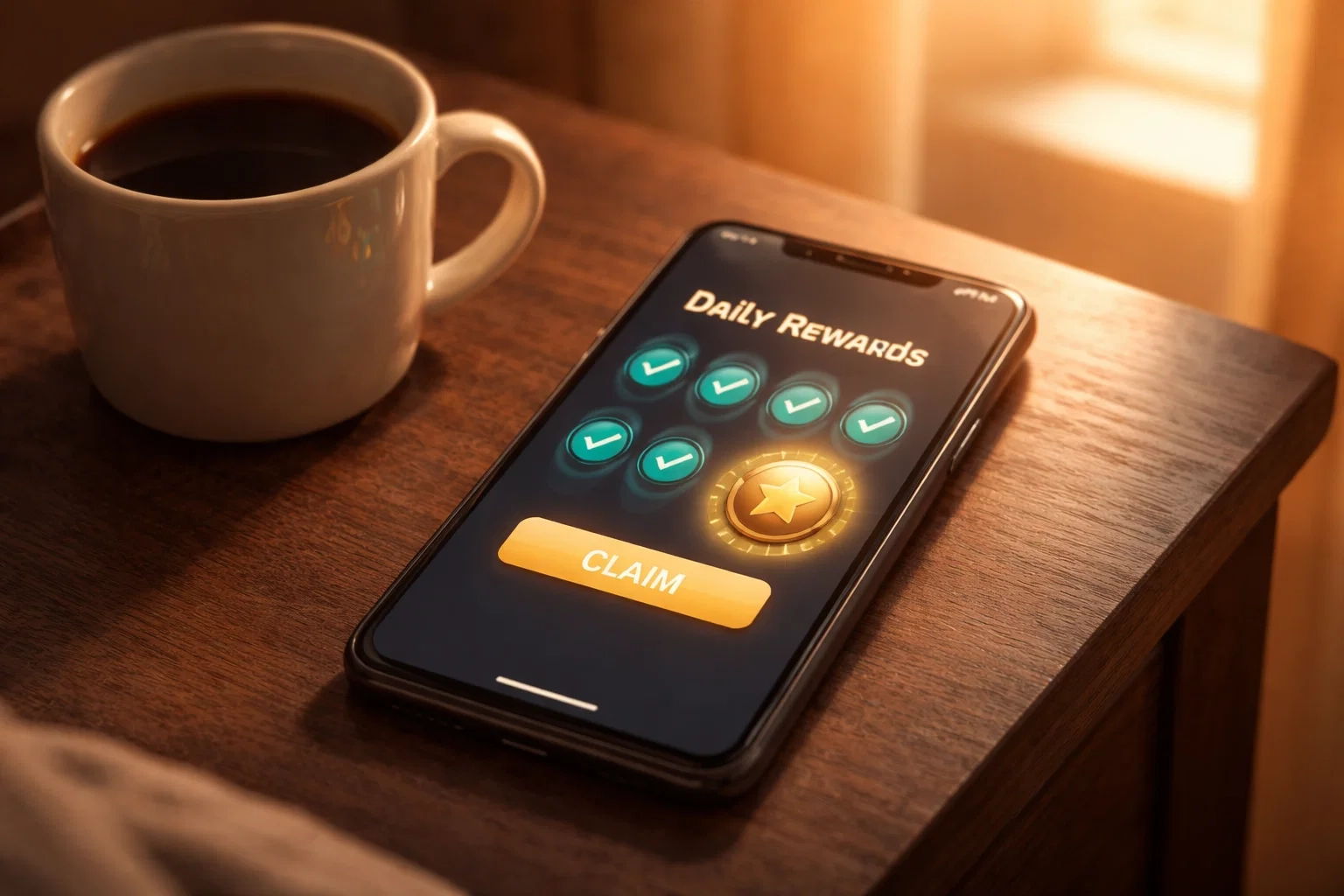
Open a sweepstakes casino app on any given morning and the first thing you’ll see is a reward notification. Free Gold Coins. Maybe a handful of Sweeps Coins. A spin on a bonus wheel. The daily drip is waiting for you — every day, without fail, as long as you show up.
Daily login bonuses are the most reliable source of free play at sweepstakes casinos, and the industry has good reason to invest in them. Research from the American Gaming Association found that 80% of sweepstakes casino players spend money on these platforms monthly, and nearly half do so every week. Daily rewards are the mechanic that bridges those sessions — a small incentive to come back today, then tomorrow, then the day after that. The bonus itself is modest. The habit it creates is the point.
Whether that habit actually benefits you depends on the numbers. Some platforms deliver genuine free-play value through their daily reward systems. Others offer amounts so small that they function more as notification bait than meaningful gameplay currency. Sorting one from the other requires looking past the animation that plays when you claim your bonus and into the actual coin values being deposited.
How Daily Reward Systems Work
The basic structure is universal: log in once per day, claim a reward. What varies is everything else — the type of reward, how it escalates, and whether breaking the streak resets your progress.
Most platforms use one of three models. The simplest is a flat daily bonus: the same amount of GC and/or SC credited every 24 hours regardless of how many consecutive days you’ve claimed. No escalation, no penalty for missing a day. The second model is a streak-based system where rewards increase with consecutive daily logins — day 1 might credit 1,000 GC, day 3 bumps to 2,500 GC, and day 7 delivers a peak reward that might include a small SC allocation. Miss a day and the streak resets to day 1. The third model uses a wheel spin or random-reward mechanic, where the daily bonus is drawn from a range. You might land on 500 GC one day and 5,000 GC the next, with SC appearing as a rare outcome.
Streak-based systems dominate the market because they’re the most effective at driving consistent engagement. The escalating reward creates a sunk-cost dynamic: you’ve logged in six days straight, and tomorrow’s day-7 bonus is the biggest of the cycle. Missing it feels like throwing away the week’s effort. That’s not an accident. The streak structure is designed to convert occasional visitors into daily users, and daily users into purchasers.
Claiming windows matter, too. Most platforms reset their daily bonus at midnight UTC or midnight Eastern, and the reward must be claimed within that 24-hour window. Some allow a grace period of a few hours. Others are strict — if you miss the window by five minutes, the streak breaks. Check your platform’s timing and set a reminder if the streak bonus is worth protecting.
Comparing Daily Bonus Values Across Platforms
Not all daily bonuses are created equal, and the differences are wider than most players expect. At the low end, some platforms credit 200 to 500 GC per day with no SC component at all — effectively worthless from a prize perspective, though adequate for free-play entertainment. At the higher end, generous platforms distribute 1,000 to 10,000 GC daily with periodic SC drops ranging from 0.1 to 1 SC, particularly on peak days of a weekly streak cycle.
The SC component is what separates a genuine daily reward from a decorative one. Gold Coins have no cash value, so receiving 10,000 GC per day sounds impressive but translates to exactly zero dollars in your bank account. A platform offering 2,000 GC and 0.3 SC daily is worth considerably more than one offering 50,000 GC and zero SC — assuming your goal extends beyond pure entertainment.
Streak peak rewards are where the real differentiation happens. A 7-day streak that culminates in 2 SC on day 7, with smaller GC-only rewards on days 1 through 6, delivers roughly 0.29 SC per day on average when spread across the cycle. A competing platform might offer 0.1 SC every single day with no streak escalation — a lower daily peak but a more consistent accumulation rate, and one that doesn’t penalize you for missing Monday. The flat model often outperforms the streak model in total monthly SC for players who can’t guarantee daily logins.
Some platforms add secondary daily rewards beyond the core login bonus: free spins on designated slots, bonus wheel entries, or social-challenge credits. These extras complicate direct comparison but can add meaningful value. A free spin on a high-RTP slot with a maximum SC payout of 5 SC might be worth more, in expected value, than the login bonus itself — though the variance is higher.
Long-Term Value: 30-Day Free Play Calculation
The daily drip adds up — slowly. A platform distributing 0.2 SC per day yields 6 SC over a 30-day month. One offering 0.5 SC per day, including streak bonuses, yields 15 SC. Over three months, those numbers become 18 SC and 45 SC respectively. At a 1:1 SC-to-dollar redemption rate, we’re talking about $18 to $45 in potential prize value per quarter — before playthrough requirements reduce the redeemable balance.
Those figures won’t fund a vacation, but they provide a baseline of free gameplay that keeps players active without requiring any purchases. And for the sweepstakes market, that free-play layer serves a crucial function. Data from Eilers & Krejcik Gaming via RG.org shows that only about 12% of sweepstakes casino users ever make a purchase, with the average transaction under $10. Daily rewards sustain the other 88% — the free players who populate game lobbies, generate social proof, and occasionally convert into paying customers.
The industry itself has recognized the need for more standardized practices around these reward systems. As Seth Schorr, CEO of FSG Digital Inc., noted when the Social and Promotional Gaming Association was formed, establishing a cohesive industry voice was a critical step for the social sweepstakes sector. That push toward standardization may eventually bring more consistency to daily reward structures — but for now, the variation across platforms remains significant, and comparing the 30-day value of different reward systems is one of the more practical ways to choose where to invest your time.
The Psychology Behind Daily Rewards
Daily login bonuses exploit a well-documented set of behavioral principles, and understanding them doesn’t make you immune — it just makes you aware of the levers being pulled.
The core mechanism is variable-ratio reinforcement: the reward schedule that produces the highest engagement in behavioral psychology experiments. When daily bonuses include random elements — wheel spins, mystery chests, or streak-peak surprises — the unpredictability itself becomes part of the draw. You log in partly for the coins and partly to see what today’s bonus looks like. The uncertainty maintains interest far longer than a fixed, predictable payout would.
Loss aversion amplifies the streak mechanic. Research consistently shows that people feel losses more intensely than equivalent gains. Breaking a 6-day streak doesn’t just mean missing day 7’s bonus — it feels like losing the accumulated progress of the entire week. Platforms leverage this asymmetry deliberately. The day-7 reward is designed to be disproportionately large not because the economics demand it, but because the psychological pain of losing it keeps players returning on days when they otherwise wouldn’t.
None of this means daily login bonuses are harmful by default. For players who enjoy the routine and treat the daily drip as a minor perk within a broader entertainment habit, the mechanic delivers exactly what it promises — free coins, no strings attached. The risk surfaces when the streak obligation starts dictating your schedule, or when the daily login becomes the gateway to an impulsive purchase. Knowing the psychology doesn’t require avoiding the feature. It requires noticing when the feature starts using you instead of the other way around.
Daily Login Rewards at Sweepstakes Casinos — More on this topic at sweep slots casino.