
First Purchase Bonuses Are Where Platforms Compete Hardest
The welcome bonus at a sweepstakes casino isn’t a gift — it’s a calculated acquisition cost. Platforms know exactly what they’re willing to spend to convert a free player into a paying one, and that number is baked into every first-purchase offer you see. According to Gaming Innovation Group’s investor data, the customer acquisition cost in the sweepstakes segment runs between $50 and $100 per user. That’s the budget behind the generous-looking packages that appear the moment you log in for the first time.
The logic is simple: front-load the value, absorb the short-term loss, and recover it through the player’s lifetime spending. A platform that gives you $30 worth of bonus SC on a $9.99 purchase isn’t being charitable. It’s making a calculated bet that a meaningful percentage of first-time buyers will return, repurchase, and generate far more than $30 in long-term revenue. The welcome bonus is the hook. Retention is the business model.
For players, this creates an opportunity. Because platforms are willing to operate at a loss on your first transaction, the real value per dollar on initial purchases is almost always higher than anything you’ll see afterward. The question isn’t whether to claim a welcome bonus — it’s which one offers the best return for your money.
How Welcome Bonuses Are Structured
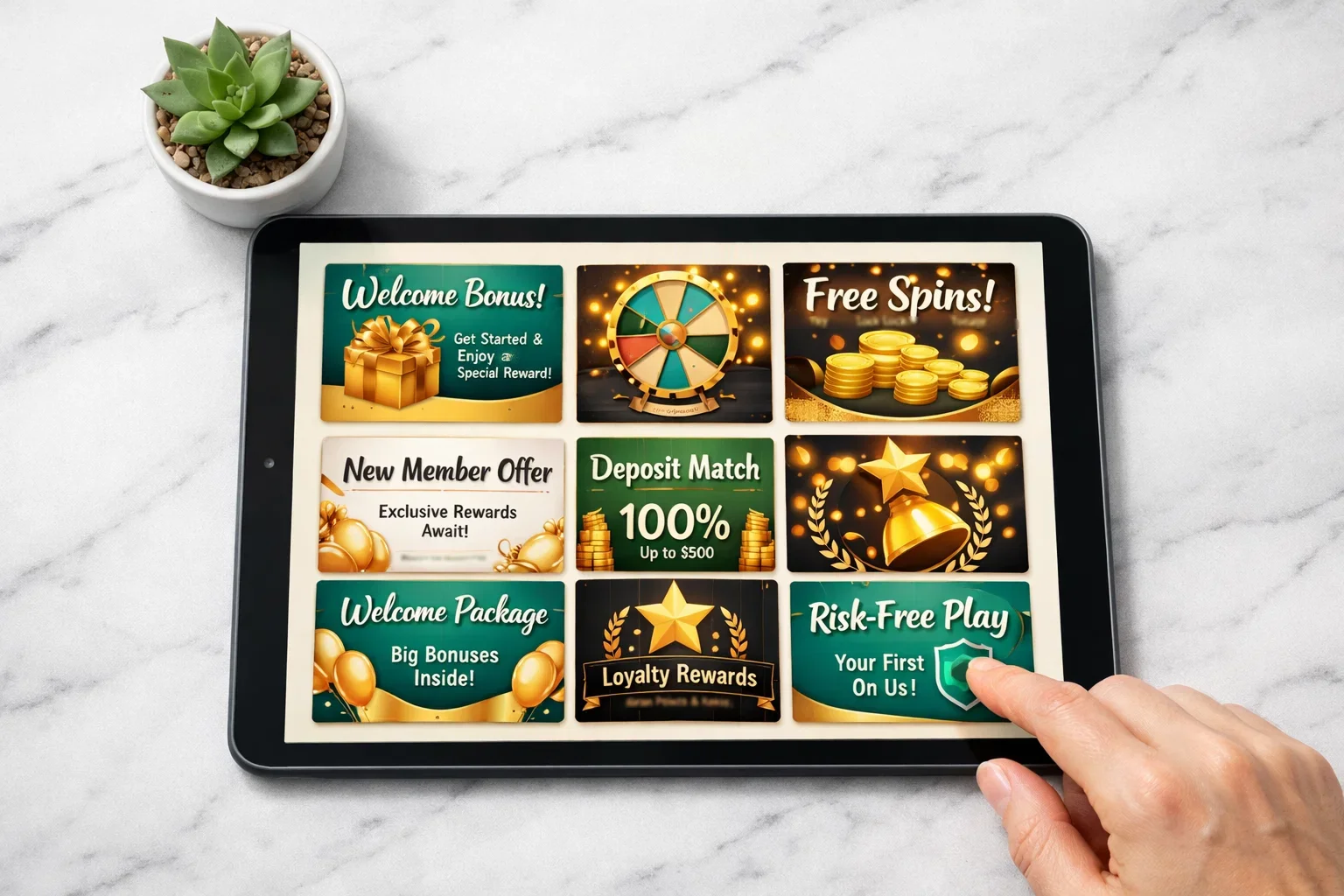
Sweepstakes casino welcome bonuses follow a consistent structure with platform-specific variations. You buy a Gold Coin package — typically priced between $4.99 and $19.99 for the introductory tier — and receive a bundle containing GC for play, plus bonus SC at a multiplied rate. The multiplier is where platforms differentiate themselves.
A standard welcome offer might work like this: purchase a $9.99 GC package that normally includes 10,000 GC and 2 SC, but with the first-purchase bonus, the same package delivers 10,000 GC and 30 SC. The SC multiplier in that scenario is 15x — you’re getting 15 times the SC you’d normally receive. Some platforms express this differently, advertising “Get 20 bonus SC free with your first purchase” rather than framing it as a multiplier. The economic result is the same.
Bonus structures generally fall into three categories. Flat bonuses add a fixed SC amount to your first purchase regardless of how much you spend. Percentage bonuses multiply the SC component by a stated factor (2x, 5x, 10x). Tiered bonuses offer different multipliers depending on which package you choose, with higher-priced packages often receiving larger per-dollar SC boosts. Tiered systems reward bigger initial spend, which is exactly the behavior platforms want to encourage.
Most welcome bonuses are available only once, only on your first purchase, and expire if not used within a specified window — typically 7 to 14 days after registration. Miss the window, and you’ll buy at standard rates forever. Some platforms extend the welcome period to 30 days or offer a “comeback bonus” for users who registered but didn’t purchase within the initial window, though these second-chance offers are rarely as generous.
Platform-by-Platform Comparison
Welcome bonus specifics shift as platforms adjust their marketing strategies, but the competitive landscape in 2026 follows recognizable patterns. Established operators with large user bases tend to offer moderate welcome bonuses — they don’t need to buy market share as aggressively. Newer entrants and mid-tier platforms push harder, offering larger SC multipliers and lower entry-price thresholds to pull players from incumbents.
At the top end of the market, the largest platforms typically bundle 2 to 10 SC with introductory packages priced at $1.99 to $9.99, with welcome multipliers boosting SC allocations by 3x to 10x. The headline numbers look different from platform to platform, but the effective SC-per-dollar ratio across the first purchase tends to cluster in a surprisingly narrow range once you strip away the marketing language.
Mid-tier and emerging platforms often advertise headline-grabbing numbers — 50 SC or more on a first purchase — but attach higher playthrough requirements or limit the bonus to specific game types. The raw SC count is only half the equation. A platform offering 50 SC with a 3x playthrough and table-game restrictions delivers less real value than one offering 20 SC with 1x playthrough and full game access.
When comparing offers, build a simple spreadsheet. List the platform, the purchase price, the total SC received (base plus bonus), the playthrough requirement, and the net value after accounting for house edge erosion. This takes five minutes and saves you from chasing a headline number that dissolves under scrutiny. The real value per dollar isn’t what the banner ad says — it’s what survives the terms and conditions.
True Value Calculation: SC per Dollar
Here’s the actual math behind that spreadsheet. Take the total SC received (base plus bonus), subtract the expected loss from wagering requirements based on the games’ house edge, and divide by the purchase price. The result is your net SC per dollar — the metric that matters most when evaluating whether one welcome offer genuinely beats another.
A worked example: you spend $9.99 and receive 30 SC with a 1x playthrough requirement. Playing the wagering requirement through a 96% RTP slot, you’d expect to retain approximately 28.8 SC (30 × 0.96). Your effective SC per dollar is 28.8 ÷ 9.99 = 2.88 SC/$1. Compare that to a different platform offering 20 SC on a $4.99 purchase with the same 1x playthrough: 20 × 0.96 = 19.2 SC retained, giving you 19.2 ÷ 4.99 = 3.85 SC/$1. The cheaper package at the second platform delivers more real value per dollar despite a lower headline number.
Industry-wide payout data adds context to this calculation. With operator-level payout rates averaging 68% to 72% according to RG.org, the system-wide return on every dollar entering the sweepstakes economy is roughly $0.68 to $0.72. Welcome bonuses temporarily push that number higher for new players — the platform is deliberately subsidizing your first session to build a habit. Once the welcome bonus is spent, your per-dollar returns drop back to industry norms.
The takeaway: welcome bonuses are the single best value point in the sweepstakes economy. Every dollar spent after that first purchase delivers less SC per dollar, less effective value, and a worse position relative to the house. If you’re going to spend at all, the real value per dollar peaks on day one.
When to Buy and When to Wait
Timing a first purchase involves two considerations: the welcome bonus expiration window and any seasonal promotions that might stack with or replace the standard offer. Most welcome bonuses expire within 7 to 14 days of registration, creating urgency. But rushing into a purchase before you’ve explored the platform with your free registration SC is a mistake. Use the free coins first. Get a feel for the game selection, the interface, the redemption policies. If the platform doesn’t meet your expectations, you’ve lost nothing by walking away with the welcome bonus unclaimed.
Seasonal events — holidays, platform anniversaries, Super Bowl weekend, and similar occasions — sometimes trigger enhanced welcome offers or limited-time promotions that overlap with the first-purchase window. If your registration falls near a major promotional event, waiting a day or two to see if an upgraded offer appears can pay off. Some platforms explicitly advertise “holiday welcome bonuses” that replace the standard offer with something more generous.
There’s also a case for waiting across platforms rather than within one. Register at multiple sweepstakes casinos, play through the free registration bonuses at each, and then make your first purchase only at the platform that feels right — with the best welcome offer, the games you enjoy, and the redemption terms you can live with. This approach takes more time upfront but ensures your first dollar goes to the right place. In a market where every platform wants to be your first purchase, the patient buyer holds the leverage.
Sweepstakes Casino Welcome Bonuses Compared — More on this topic at sweep slots casino.